Spoken languages have had writing systems for thousands of years. Sign languages, by comparison, have mostly existed only in the moment, seen and then gone, with no standard way to write them down. One woman’s background in ballet changed that.
From Ballet Steps to Sign Language
SignWriting traces back to an unlikely source: dance notation. Valerie Sutton invented DanceWriting in 1966, at just 15 years old, while training as a professional ballet dancer, creating a stick-figure notation system to record ballet steps for her own personal use. She later trained with the Royal Danish Ballet in Copenhagen, where she used her system to preserve historic Danish ballet choreography that was at risk of being lost simply because no one had ever written it down.
In 1974, sign language researchers at the University of Copenhagen took notice. They needed a reliable way to record the signs and gestures they were studying on videotape, and they approached Sutton to ask whether her movement notation system could be adapted for that purpose. Over the following years, Sutton developed SignWriting through continued collaboration with researchers and Deaf communities in the US, including work with the National Technical Institute for the Deaf and the National Theatre of the Deaf.
Built With Deaf Communities, Not Just For Them
SignWriting’s development didn’t stop once the basic system existed. In the early 1980s, Sutton began publishing a quarterly newsletter called “The SignWriter Newspaper,” written by Deaf journalists skilled in the system and distributed free of charge to Deaf readers in 41 countries. Feedback from those readers directly shaped how SignWriting evolved into a general-purpose writing system. In 1988, the Deaf Action Committee for SignWriting was founded by Deaf people skilled in the notation, who went on to work alongside Sutton producing books, dictionaries, and software.
A Writing System for Any Sign Language
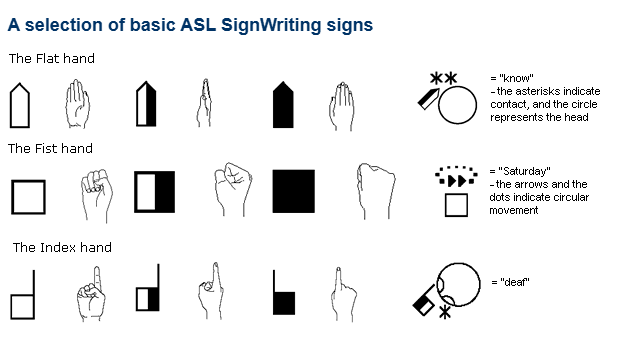
What makes SignWriting distinct is its design as a “movement-writing-alphabet,” a visual system that can represent handshapes, movement, and facial expression for essentially any signed language, rather than being built around one specific language’s grammar. Today it has been used to write at least 27 different sign languages, and it earned recognition as an official Unicode script in 2015, meaning SignWriting text can now be rendered consistently across computers and devices worldwide, the same technical foundation that lets any written language display properly online.
Why This Matters for International Sign
A visual, language-independent notation system like SignWriting is a natural fit for something like International Sign, which has no single fixed grammar and draws on shared, evolving vocabulary from many national sign languages. While IS doesn’t have one standardized written form, tools like SignWriting point toward a future where even a bridge language like IS could be documented and shared in writing, not just passed along person to person at international events.
The Takeaway
Before SignWriting, sign languages existed almost entirely as spoken languages once did before writing: rich, complex, and completely undocumented in visual, textual form. Valerie Sutton’s background in ballet notation turned out to be exactly the right toolkit to change that, one handshape symbol at a time.
Interested in International Sign or the global Deaf community? Follow OneDeafWorld.com for more coverage of IS, accessible technology, and events from around the world.